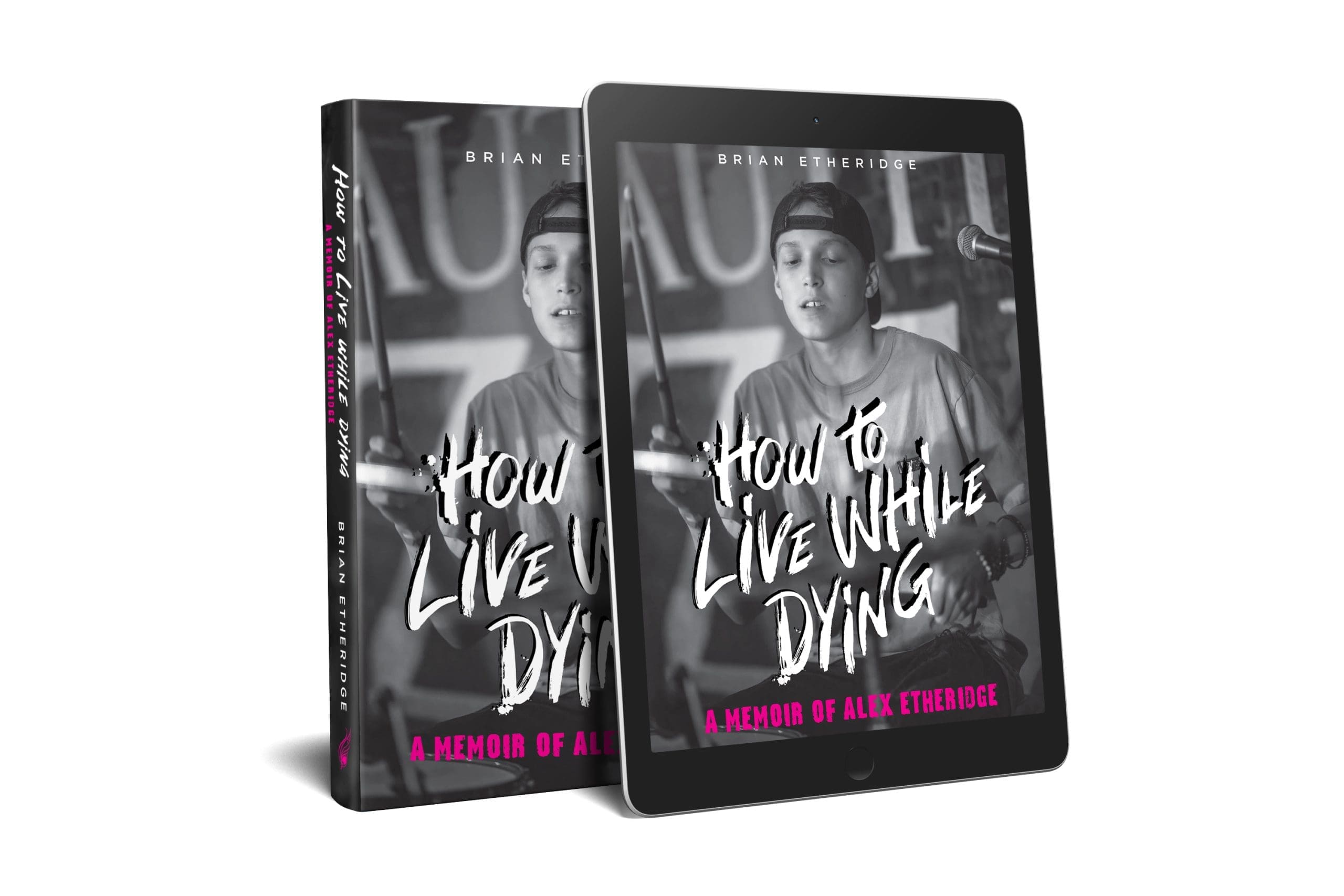
This blog is an excerpt from Chapter 3 of Brian Etheridge’s book, How to Live While Dying: A Memoir of Alex Etheridge.
Nothing demonstrates that life hangs in a delicate balance like giving poison as a medicine to a child and hoping that it kills what ails him without killing him. As we accepted the reality that our twelve-year-old son, Alex, had cancer—and whether he’d live long enough to drive a car depended on the success of his treatment—we had many hard conversations parents don’t normally have with their preteen children.
How do you tell your child he has an illness that might kill him? How do you tell him the treatment is going to make him miserable for seven months? How do you tell him that every plan he had, everything he enjoyed, everything he looked forward to has to be paused for twenty-nine weeks while he sleeps, vomits, and struggles to enjoy basic human functions like eating and drinking? What is the age-appropriate way to answer the question: “Dad, how will osteosarcoma kill me?”
I told Alex I didn’t know the answer to that last question, but I’d find out.
The most emotionally draining conversations we had while he recovered from his first chemo treatment were about eating. Chemotherapy creates one of the greatest conflicts in medicine. You have to eat to maintain a minimum body mass to continue the treatment, while the treatment makes you hate eating and reject the sight and thought of food. We had many “food fights.” I alternated between commanding him, begging him, and persuading him with logic that he needed to eat.
“You have to eat. Even if it tastes bad,” I told him when he dropped below ninety pounds. “Even if it makes you nauseous. Take it slow. One bite at a time. But you have to eat. This is a choice between eating and not existing. We can’t look at food as an experience to enjoy, to savor, or to look forward to. We have to look at food as the fuel that powers your fight. That’s it. We can enjoy it later. We can enjoy it again when this is behind us.”
He understood, but it didn’t make eating any easier. It’s hard to eat when you aren’t hungry. Anytime we pressed him to eat, he rolled his eyes, and his whole body rolled with them. His body simply did not want food. But he hated conflict, especially conflict he couldn’t resolve, and he did his best.
Alex liked order. He liked his bed made. He liked having a routine he could follow every day. He liked to know and follow the rules. I think that’s part of what made him fall in love with the drums. Rhythm makes sense. It has logic. It has rules. When he understood why he had to power through eating, and we were able to devise a mathematical formula he could understand, he was able to eat.
But what twelve-year-old wants to think about food in those terms? Twelve is the age for pizza parties and stuffing themselves on candy. For Alex, now, food was only about survival.
During the hard days, we reminded him he had agency. We knew he would be much more willing to endure the suffering if he was the one making the decisions to pursue treatment. We made it clear to him that this was his life, his journey, his decisions.
“You have a voice in this and need to feel free to use it,” we told him during one of his bad days. “Ask your questions. Share your concerns. Embrace your emotions. Everyone in our family is going to react to this differently. None of those reactions are wrong. Your feelings are your feelings. Recognize them, accept them, share what you are comfortable sharing. Your mom and I are both scared and optimistic. We are proud of the strength you are showing. You are more adult than we give you credit for.”
I was crying pretty badly during this conversation. I’ve always known raising a child involves mastering the art of letting go, one year at a time, but I always imagined “letting go” meant observing my child build a life without me at college in another town, not watching him die.